Thursday, September 25, 2008

The 4 P's, the 7 P's... and beyond - Part One


The original "Marketing Mix" term as was coined by Professor Neil Borden, of Harvard Business School, in the 1950's


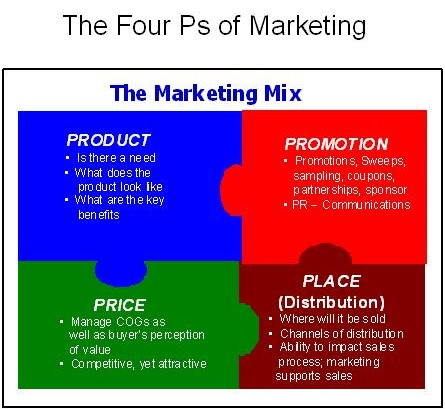
Jerome McCarthy later proposed that a marketing mix was reliant on 4 aspects, all starting with P. They are;

Product
Price
Promotion
Placement (place or distribution)

I'll admit that, as I see it, these four P's cover marketing needs quite well. However, the more time I spend on the interweb, the more I am bombarded by more, extra, and replacement P's.

I've read many websites which have tried to add extra P's for the sake of covering an area that was undefined, or unheard of, during the identification of the original 4. There have also been movements to better adapt the 4 P's to the sale of different types of products, services, and ideas - evidenced by Purple Cow and Presto.

I dedicate this blog to these New/Replacement P's in the marketing mix.

I found one particular site that did nothing but give the 10 P's along with a short explanation and credit for identifying the P.

10 Ps of the marketing mix

  1. McCarthy's (1960) traditional marketing mix consists of Product, Price, Place and Promotion
  2. Kotler (1984:1986) added 2 more Ps - Public relations and Political Power
  3. Magrath proposed another 3 more Ps to meet the needs for marketing in service-based industries - People, Physical evidence and Process
  4. Y.S.Chin believes that Packaging should be considered another P in the marketing mix
That's the whole website... honest.

I think this new website sets the stage for a lot of study, as well as controversy, in the field of marketing as it pertains to the marketing mix. To start I think that just leaving these few words as the only explanation for the extra p's is a little cryptic. Other sites just contend to listen to the current crop of buzz words created to sell marketing books and argue the relevancy of mix factors, which are very unfortunately named in some cases, like Purple Cow and Pro Bono.

Maybe a little more interweb research will be able to enlighten us "uninitiated" to these new marketing mix factors, and their relevancy in today's marketing world...

In an interweb search, which took no more than an hour, I was able to make the following list of Marketing Mix.

~ Starting with the original 4 (Product, Price, Promotion, Place)

~ I found 6 New P's (People, Physical Evidence, Process, Packaging, Partnership, Programming)

~ 1 extra P all by itself (Philosophy)

~ An entirely new set of 10 P's (Price, Purchases, Points, Partners, Prizes, Pro Bono, Privileges, Personalization, Participation, Presto)

~ And last, but not least, Seth Godin's New P's (Priceless, People, Pennies, Purple Cow)

I'll try my best to differentiate these P's from the original 4. But that will definitely have to wait for Part Two - I'd rather keep these post short due to the scroll lag I've seen some blogs cause.

See you then.

Monday, September 22, 2008

The 5 Dysfunctions of a Team

I came across this very beautiful book recently in my many Webcrawler searches for random way to increase my knowledge and productivity. The name of the book is The Five Dysfunctions of a Team and it was written by Patrick Lencioni.

Note: The summary of the five dysfunctions is taken directly from Wikipedia, cut and past style - mostly because I find that typing becomes a very weary task for me after searching for countless hours on the interweb.

1) Absence of Trust

The first of the dysfunctions, absence of trust, stems from teams unwillingness to be vulnerable within the group. Team members who are not genuinely open with one another about their mistakes and weaknesses make it impossible to build a foundation for trust.


2) Fear of Conflict

This failure to build trust is damaging because it sets a tone for the second dysfunction: fear of conflict. Teams that lack trust are incapable of engaging in unfiltered passionate debate of ideas. Instead, they resort to veiled discussions and guarded comments.


3) Lack of Commitment

A lack of healthy conflict is a problem because it ensures the third dysfunction of a team: lack of commitment. without having aired their opinions in the course of passionate and open debate, team members rarely, if ever, buy in and commit to decisions, though they may feign agreement during meetings.


4) Avoidance of Accountability

Because of this lack of real commitment and buy-in, team members develop an avoidance of accountability, the fourth dysfunction. Without committing to a clear plan of action, even the most focused and driven people often hesitate to call their peers on actions and behaviors that seem counterproductive to the good of the team.


5) Inattention to Results

Failure to hold one another accountable creates an environment where the fifth dysfunction can thrive. Inattention to results occurs when team members put their individual needs (such as ego, career development, or recognition) or even the needs of their divisions above the collective goals of the team.

*******

So now your thinking, WHY? What does this have to do with marketing. Well that's quite simple. Marketers, for the most part, are the most "extroverted" people in existence. Marketing is not done in a dark room at the bottom of a set of unlit stairs by a person hunched over an enormous desk - that's accounting silly.

All jokes aside, Marketing is a team effort and cannot be exercised in a vacuum. Teams in the field of Marketing can consist of many different internal and external groups that you, as a Marketer, will have to work with peacefully and productively to reach objectives and reach goals.

Acquiring as many skills as possible, relating to teamwork and cooperation, and learning how to avoid these "team pitfalls" is just as important as knowing your target market or properly implementing your marketing mix...

...hmmmm the Four P's, sounds like fun. There's a can of worms I'll be taking on in the next couple of days.

Sunday, August 10, 2008

Why Comet & Fly?

I guess explanations are in order... Why in the world is this blog called Comet & Fly, especially if it's not about a comet or a fly, but the business aspects of Marketing?

First things first... The Blog's not just about Marketing as a whole. I love marketing and it's fields, especially Advertising, Communications, and Sales. And I'll be blogging about all of these different subjects for the foreseeable future.

Second things second... Comet & Fly was an idea for a comic book, conceived in high school, by myself and a friend. The idea was to create a comic, no unlike some 80's Cartoons, that could be used a vehicle to sell merchandise - little did we know how much involved we were in the world of marketing without even knowing it.

The idea came and went, and the both of us moved on to other projects, without much thought about how far the Comet & Fly concept might take us. Now, as to answer the question I posed earlier without getting too long-winded, this blog is dedicated to that high school concept and as reminder that Marketing touches every aspect of my life, and that's why it's so much fun.

Thursday, February 28, 2008

Welcome!

I recently became aware of Heinlein's Rules. There are five of them.

Rule One: You must write

Rule Two: Finish what you start

Rule Three: Refrain from rewriting... Except to editorial order

Rule Four: Put your story on the market

Rule Five: Keep it on the market until it's sold

Now I'm not saying that these rules were a HUGE eye-opener. I was really impressed at the guys ability to pair down all those Writing Books, which sometimes have encyclopedic-like page counts, and give them to us in a few, very short, FREE sentences.

This blog is basically a way for me to write, in relative peace, about whatever I want. Random thoughts, short, stories, news, and anything else my conscious, or unconscious, mind decided to let me have. Just as long as it's somehow based in the world of Marketing.

Oh yeah... Welcome to Comet & Fly